
A seed packet is not one bet. It can be three smaller bets.
NOAA’s August 9 outlook favors another warm stretch across much of the South.
That matters if you are thinking about a fall lettuce crop.
Lettuce likes cool weather. A hot spell can slow young plants, make leaves bitter, or push older plants to bolt.
The usual mistake is easy to make: wait for one free Saturday, plant the whole packet, and hope that one date was right.
A planting date is a weather bet.
Today we will split one bet into three chances.
What feeds the family while the first row is still small?
A home garden grows skills and fresh food. A long-life food buffer covers the weeks when weather, pests, or timing do not cooperate. This 4Patriots package is one way to add that second layer.
INSTALL PREVIEW
Print this issue and put it in the planting section of your 4 Foot Farm binder.
Today’s install is the Three-Date Strip. In 15 minutes, you will split one four-foot row into three small sowing zones and mark dates one week apart.
ACTION BRIEF
Signal: NOAA favors above-normal heat across much of the southern United States in mid-August.
Garden risk: one hot week can punish a whole one-day planting.
Pattern: small waves spread weather risk and stretch the harvest.
Install: mark three feet, sow one today, and date the next two.
CURRENT SIGNAL
The Climate Prediction Center issued a new outlook on August 9.
For August 15–19, it favors above-normal heat across much of the South. The Southeast has the strongest chance. Parts of the Gulf Coast and Florida also lean drier than normal.
The next week stays warm across much of the country.
Your local forecast may differ. Check it before you sow.
The University of Maryland Extension says lettuce is a cool-season crop. It can be planted in late summer for a fall harvest. It also says lettuce does best in succession or with varieties that mature at different times.
That word, succession, sounds fancy. It just means do not plant everything on one day.
If today’s seeds meet bad heat, next week’s seeds may meet better weather. If all three grow, you get a longer harvest instead of one pile of leaves at once.
Would a second water path make the next row easier to trust?
This sponsor presentation shows a home water device meant to create another source. Review the method and claims with care. A garden still needs an honest water plan before it needs more seed.
PARALLEL 1: THE 1943 VICTORY GARDEN

USDA’s 1943 guide asked households to ease pressure on farms, trucks, and cans.
In 1943, the United States was deep in World War II. Farms were producing, but the food system had other jobs too.
USDA’s Victory Gardens guide said labor and machine shortages made farm work harder. Railroads and trucks were crowded with war needs. Steel and tin were scarce, which made canned food harder to pack.
The government asked farm families and town families to grow what they could at home.
The guide did not promise that one backyard would replace a farm. It showed the power of many small gardens. In 1939, before the wartime push reached its peak, 4.8 million farm home gardens had already grown more than $200 million worth of vegetables, not counting potatoes and sweet potatoes.
The lesson was not just “plant more.” It was “use space and time well.” Garden guides told families to plan crops for different seasons, store what would keep, and preserve extra food.
A family that planted every lettuce seed on one day could get too much lettuce at once. Or one hot spell, pest wave, or hard rain could hit the whole crop.
Planting in waves turned the calendar into another piece of garden space.
That idea matters in four feet. You may not have room for three big beds. You do have room for three dates.
The scale is smaller now. The rule is still useful: when space is tight, time becomes a second garden bed.
One foot today, one foot next week, and one foot the week after can produce a steadier harvest than all three feet planted at once.
PARALLEL 2: ROME’S LETTUCE CALENDAR
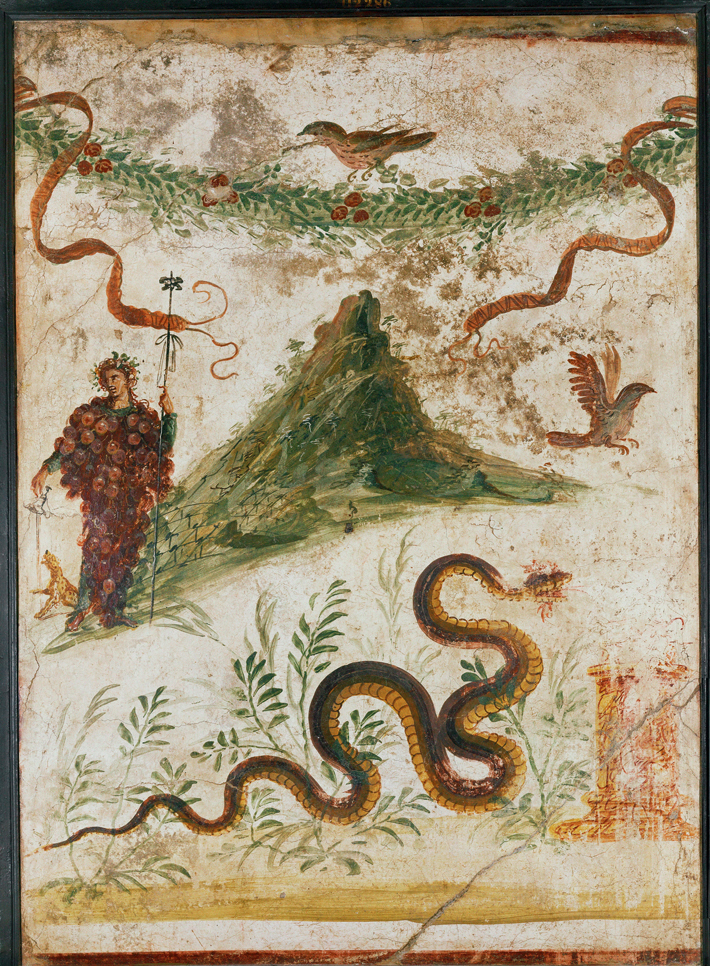
Roman writers treated variety and timing as tools, not side notes.
Around A.D. 77, the Roman writer Pliny the Elder finished much of his Natural History. Book 19 looked closely at garden plants.
His lettuce section listed many kinds. He described black, white, red, purple, crisped, Greek, and Cappadocian lettuces.
One detail is easy to miss. Pliny said some growers chose sowing time by variety: black lettuce in January, white in March, and red in April. He wrote that the plants could be moved about two months later.
The exact Roman calendar is not a planting guide for your ZIP code. Their names may not match modern seed packets. Their soil, weather, and plants were different.
But the thinking is sharp.
Roman growers did not treat “lettuce” as one thing with one perfect date. Variety and season worked together. A kitchen garden close to the house also made small, repeated care easier.
Modern gardeners have better tools. We have local frost dates, ten-day forecasts, slow-bolting seed, shade cloth, and written days-to-maturity.
Yet we often make a simpler plan than the Romans did: buy one packet and plant it all.
A better four-foot plan uses both variety and time. Pick a leaf lettuce that handles some heat. Sow a small amount. Wait seven days. Look at the forecast and the first row. Then sow again.
You are not trying to outguess the whole season. You are buying three chances with one packet.
THE PATTERN TO NOTICE
Across BOTH examples, the pattern is this: a small garden gets stronger when the harvest is spread across time.
HOUSEHOLD LESSON
Do not make one planting date carry the whole fall crop.
Split the row. Split the seed. Split the risk.
HOUSEHOLD INSTALL: BUILD THE THREE-DATE STRIP
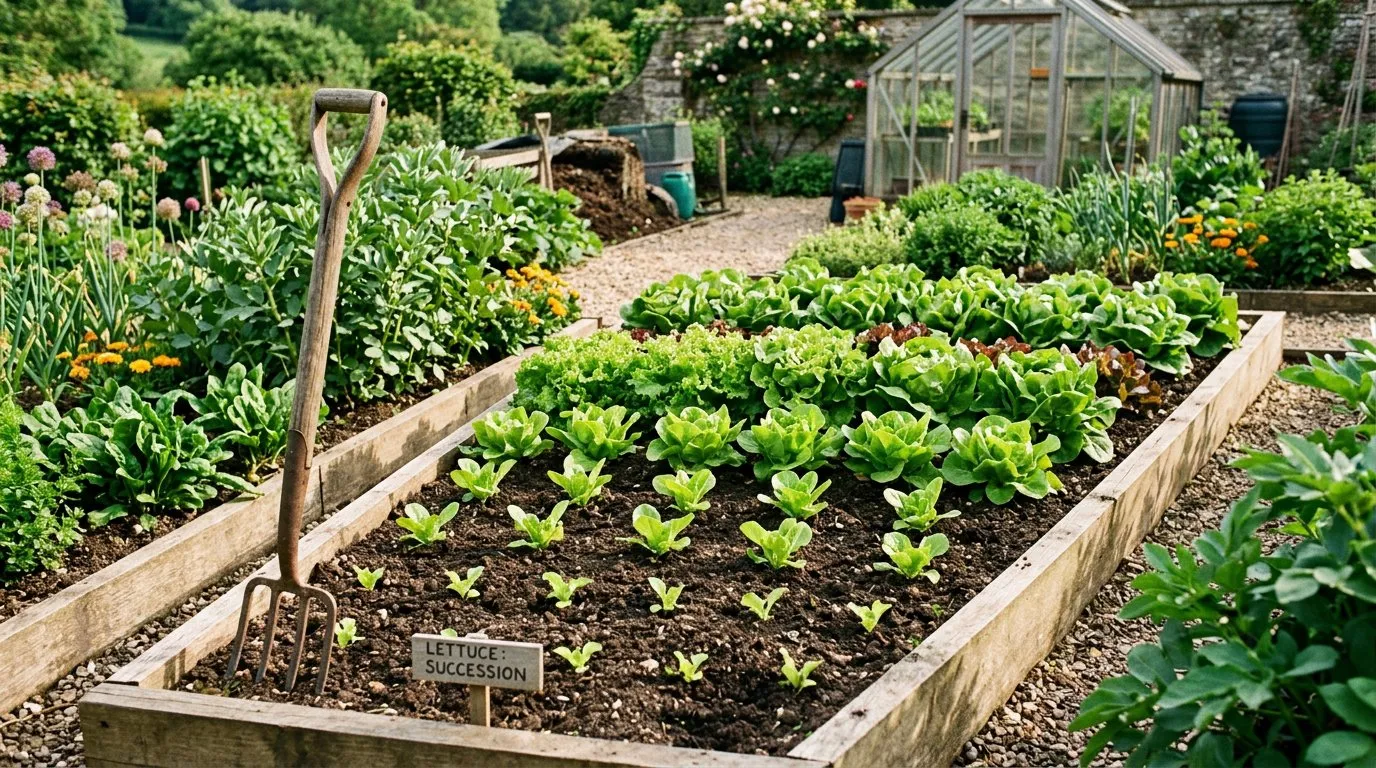
Three small waves can turn one row into a longer harvest.
This takes 15 minutes. You need lettuce seed, a ruler or scrap stick, three markers, and water.
Choose the strip. Use three feet of a four-foot bed, box, trough, or wide pot.
Mark three zones. Each zone should be about one foot long.
Sow zone one. Follow the packet depth and spacing. Do not use more than one-third of the seed you set aside.
Date zones two and three. Write +7 days and +14 days on two markers.
Add one heat edge. Give the strip afternoon shade or use a cheap piece of light shade cloth. An old sheer curtain can work if air moves through it.
Measurable win: one row now carries three weather chances and three likely harvest windows.
STATUS CHECK
□ Three zones marked
□ One-third of seed sown
□ +7 day marker placed
□ +14 day marker placed
□ Afternoon shade checked
A TOOL THAT FITS TODAY’S PATTERN
A garden needs time. This sponsor’s freeze-dried food offers a shelf-stable bridge while your first, second, and third rows grow.
THE FARM TAKEAWAY
One packet.
Three dates.
Three chances to meet better weather.
Do not ask one Saturday to predict the whole fall.
Keep growing,
Sam McCoy, Creator
Today’s lesson: When space is tight, time becomes another bed.
P.S.
What would you plant in a three-date strip: lettuce, radish, spinach, or something else? Hit reply and tell me. Forward this issue to a friend who plants the whole packet at once.
P.P.S. GROW THE NEXT LAYER
Self Reliance Report: The Two-Meal Buffer — give two family meals a second path.
The Ready Report: The Coolest-Room Card — find the room that gives your family a heat edge.
Ready to turn the four-foot strip into a full plan?
The 4 Foot Farm Blueprint shows beginners how to choose the space, plant useful food, and keep the system moving.
Sources reviewed for this issue: NOAA Climate Prediction Center, August 9, 2026 outlook discussion; University of Maryland Extension, Growing Lettuce in a Home Garden, updated March 25, 2026; USDA National Agricultural Library, 1943 Victory Gardens guide; Pliny the Elder, Natural History, Book 19, chapter 38, Perseus Digital Library; recent 4 Foot Farm Blueprint post metadata and Household Resilience Network reference files.